Seasonal Meta-Progression
A 13-week Battle Pass progression model for a solo Battle Royale. Anchored to match survival time and cumulative weekly quests, calibrated to keep progression viable and absence-resilient without requiring match wins.
Season: 13 Weeks (91 Days) · Structure: 100 Tiers (30 Free / 70 Paid) · Pacing: 1,000 XP/Tier · Baseline: 0 Wins
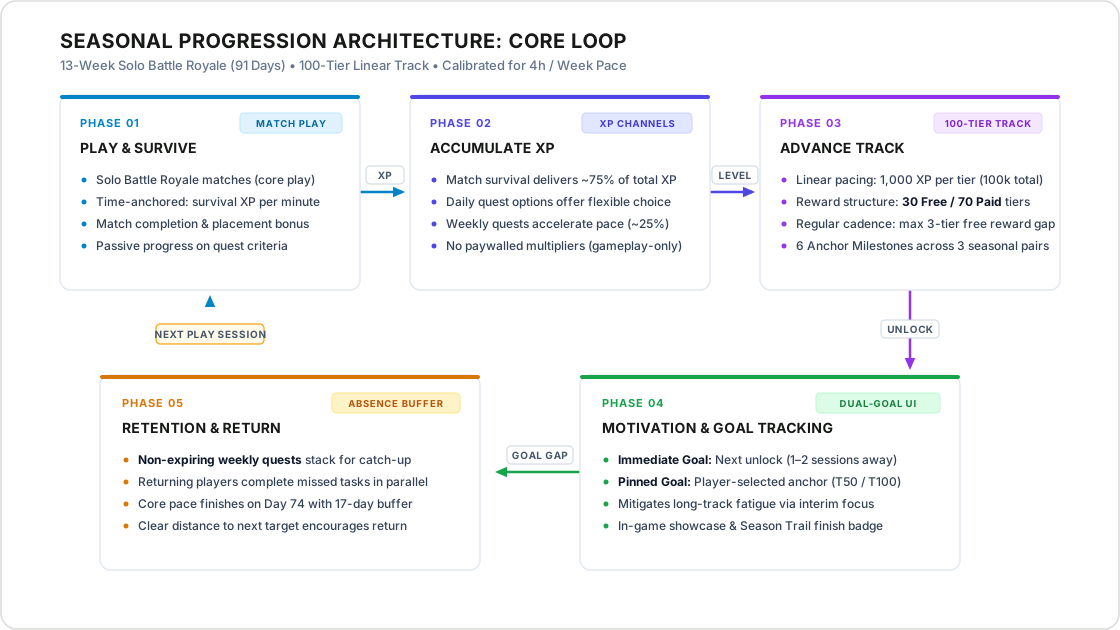
The Core Meta-Progression Loop
In solo Battle Royale, only one player wins each match. Progression cannot rely solely on victory without leaving most matches feeling unrewarded. This meta-loop anchors progress to match survival time and concurrent quests, pairing immediate session feedback with long-term seasonal milestones.
Mitigating Long-Track Fatigue
A 100-tier track feels distant if the only visible milestone is 40 hours away. The interface anchors players to two concurrent targets: the immediate next unlock (1–2 sessions away) and a player-pinned anchor (such as Tier 50 Trail Runner), breaking the season into manageable psychological stretches.
Absence Resilience
Weekly quests never expire during the season. Returning players after an absence do not face an unachievable gap or FOMO; their accumulated weekly quests progress concurrently in regular matches, preserving achievable season completion.
Reward Cadence & Free Track Guardrails
30 Free and 70 Paid rewards are interleaved with a strict pacing guardrail: free players never face more than 3 paid-only tiers in a row. At ~1,740 XP per hour, non-paying players earn a tangible unlock every 1–2 sessions without progression deserts.
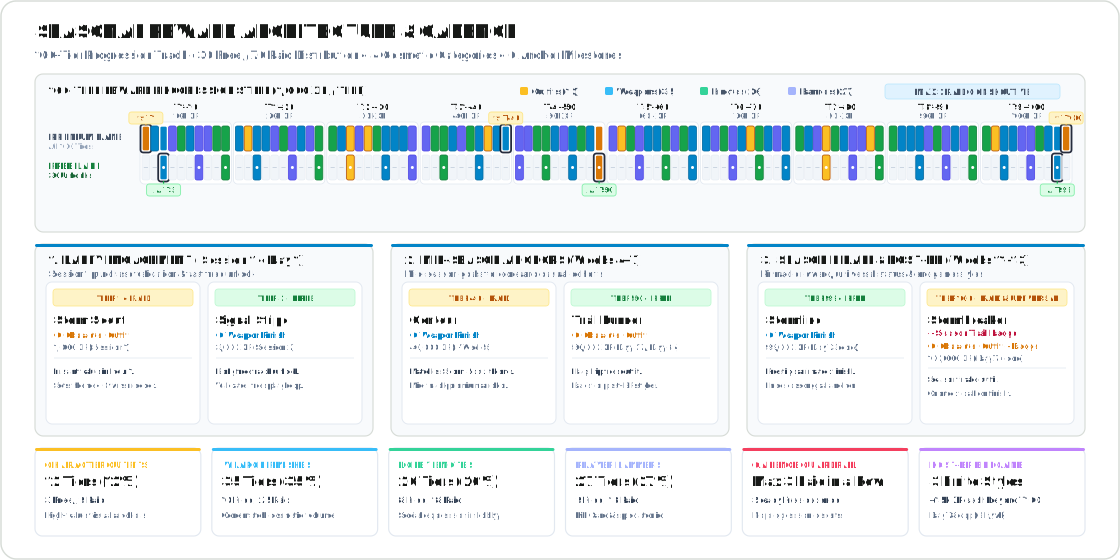
The reward track is anchored around six milestone unlocks across the 91-day calendar:
- Tier 1 (Paid): Storm Scout character outfit gives immediate Day 1 purchase validation.
- Tier 3 (Free): Signal Stripe weapon finish validates the free loop by Session 2.
- Tier 40 (Paid): Contour weapon finish anchors mid-track progression around Week 5.
- Tier 50 (Free): Trail Runner flagship free character outfit reached on Day 37 (core) / Day 64 (casual).
- Tier 99 (Free): Stormline weapon finish serves as the prestige free anchor.
- Tier 100 (Paid & Universal): Stormbreaker pinnacle character outfit and animated season trail badge.
Cosmetic volume is divided across four categories: 12% Outfits (3 Free / 9 Paid), 35% Weapon Finishes (10 Free / 25 Paid), 26% Lobby Emotes (8 Free / 18 Paid), and 27% Player Banners (9 Free / 18 Paid). Post-Tier 100 XP feeds three finite bonus styles (+15k XP each), absorbing surplus playtime without infinite grind.
Survival Carries, Quests Accelerate
Progression is anchored in match survival time rather than quest completion. Quests accelerate pacing and provide an absence buffer, but never act as progression gates.
Match XP = 30 × survival_min + 75 (finish) + 250 × winDaily Quest = 200 XP/day (1 of 3 options completed)Weekly Quests = 3 × 750 XP (2,250 XP/week)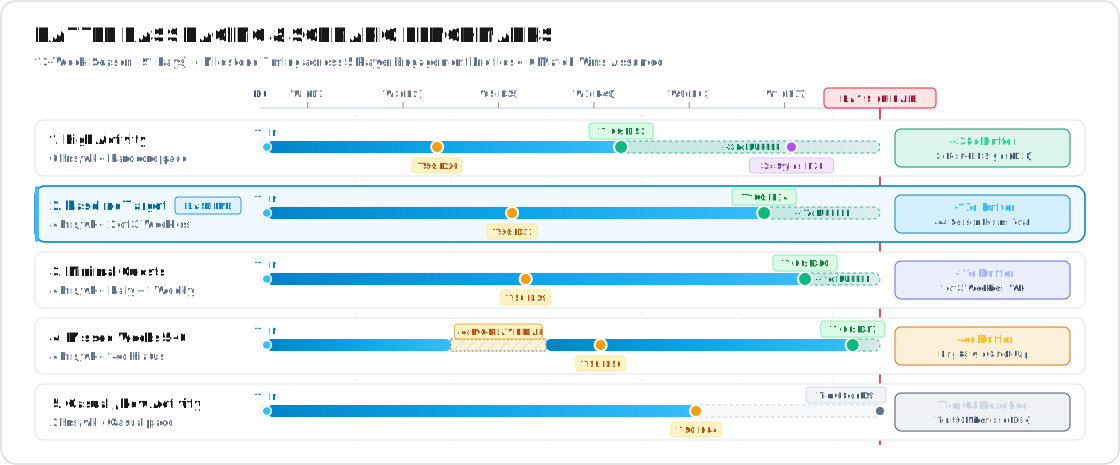
Progression Model Structure
The progression model is built in Google Sheets and Excel to evaluate pacing across different player archetypes. It connects 25 balance parameters to 14 deterministic player scenarios, allowing instant recalculation of season milestone timings when adjusting match XP, survival rates, or quest rewards.
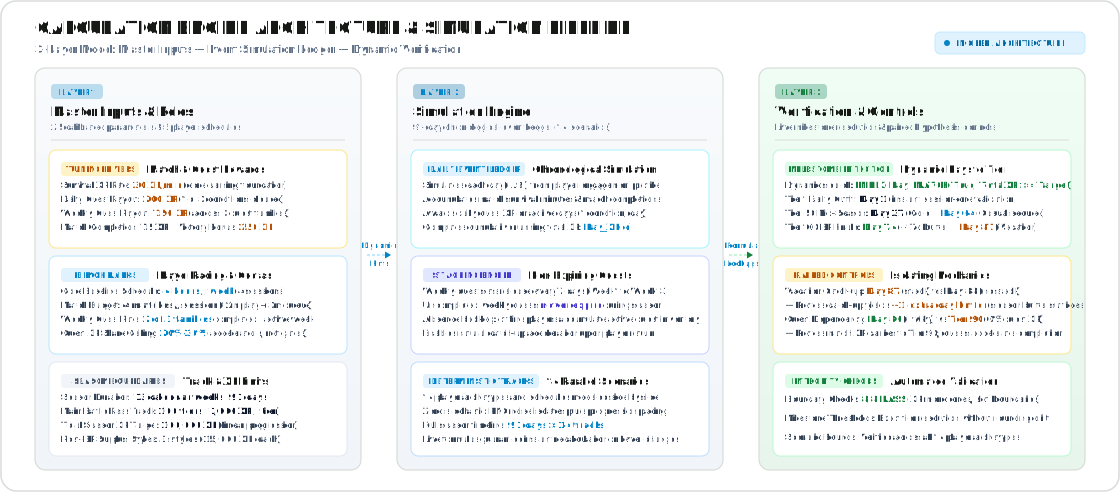
The calculation engine uses a 3-layer architecture to isolate parameters from scenario verification:
- Layer 1 (Master Inputs & Roles): 25 calibrated levers (survival rate, completion bonus, quest quotas, track boundaries) configured alongside 5 baseline player schedules.
- Layer 2 (Simulation Engine): A 91-day chronological event ledger mapping daily session minutes, active quest inventories, and non-expiring catch-up queues across 14 deterministic tracks.
- Layer 3 (Verification & Controls): Dynamic lookups (
INDEX/MATCHagainst cumulative XP targets) measuring milestone unlock days, paired hypothesis buffers, and boundary pass/fail integrity checks.
Inspect all parameters and formulas in the live spreadsheet: Open Model & Assumptions sheet ↗.
Decisions & Trade-offs
Key balance adjustments made during model calibration to resolve friction between progression pacing and player experience:
1. Survival Time vs. Skill-Based XP
2. Combat Quests via Match Budgets
3. Non-Expiring Weekly Catch-up
Math vs. Assumptions
Clear distinction between deterministic mathematical models, baseline assumptions, and behavioral hypotheses that require live validation:
Progression Math
Exact XP pacing, tier thresholds, quest stacking formulas, and completion dates for each tested play schedule.
Player Profiles
Session length (60 min), weekly cadence (2–6 sessions), and survival rate (12 min) are calibrated design baselines, not telemetry.
Player Behavior
Whether dual-goal UI prevents mid-season drop-off and how players value cosmetic tiers must be validated in playtests and soft launch.
Progression Model Spreadsheet
All balance levers, pacing parameters, and scenario calculations are maintained in Google Sheets (XLSX export available in viewer).
Bonding System: System Design & Balancing →
A progression system that makes the relationship with an individual horse visible through gameplay and expressive 3D stall behaviours.